

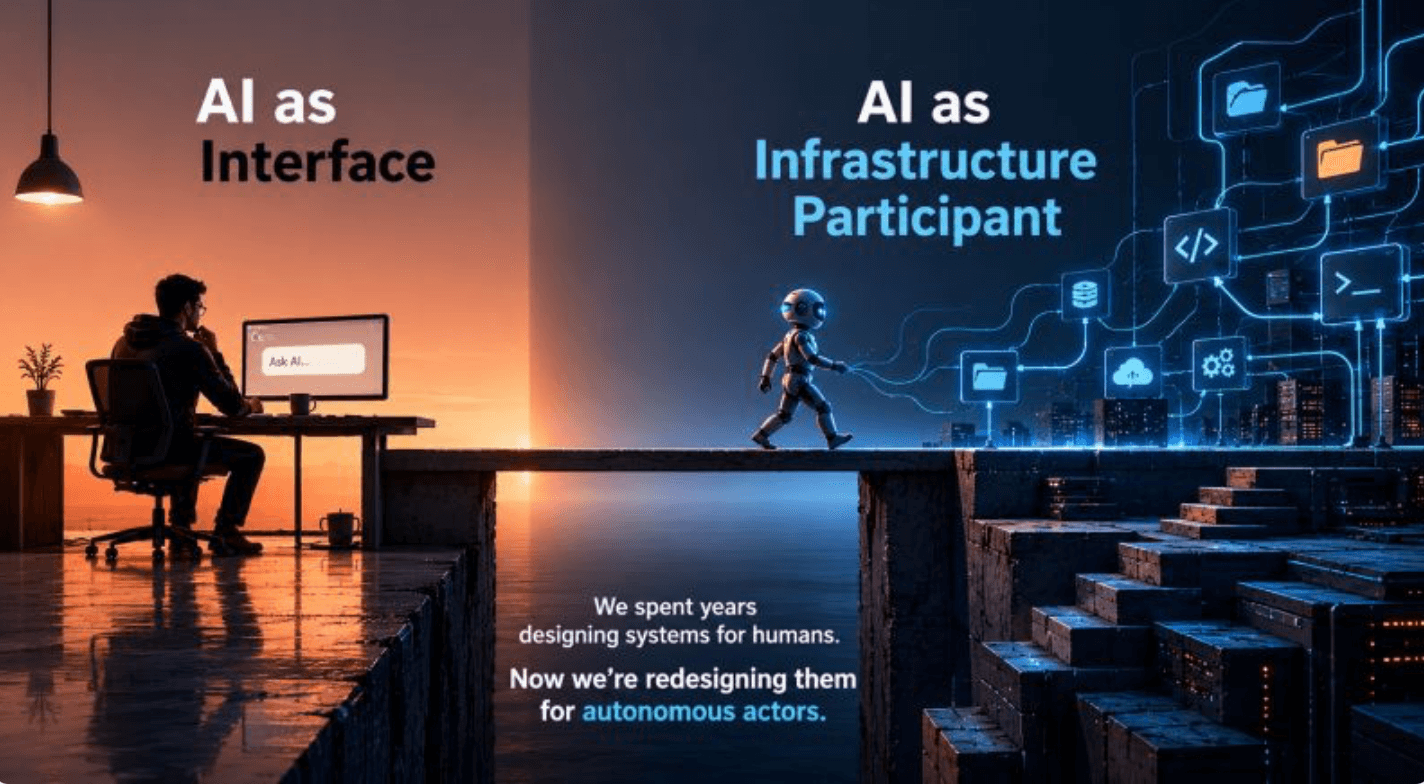
For the last two years, we treated AI like an interface: a chatbot, a copilot, a better search box.
But the shift is becoming obvious. We are moving from AI as interface to AI as infrastructure participant.
AI systems are no longer just answering questions. They are starting to participate in the operational layer of software systems.
They are:
- opening pull requests,
- managing files,
- operating browsers,
- invoking tools,
- interacting with APIs,
- and making operational decisions autonomously.
The Challenge Is No Longer Only Intelligence
Model quality still matters. Better reasoning, better retrieval, and better task completion are important.
But the deeper challenge is now structural:
- Trust: Which actions should the AI be allowed to take?
- Permissions: What can it access, modify, or execute?
- Observability: Can we reconstruct what happened after the fact?
- Governance: Can teams prove that autonomous behavior stayed inside policy?
This is where many AI programs become fragile. They treat the model as the product, while the real operational risk lives around the model.
Software Was Designed for Human Actors
Most software systems were designed around human assumptions.
Humans clicked buttons. Humans approved changes. Humans read warnings. Humans owned accountability.
Autonomous AI changes that model. It introduces a new class of actor inside the system: one that can read, write, call tools, and take action at machine speed.
That requires a different governance posture.
From Application Features to Infrastructure Controls
The next generation of AI systems will need controls that look less like UI features and more like infrastructure:
- scoped permissions,
- action-level logging,
- policy enforcement,
- evidence trails,
- rollback paths,
- human approval gates,
- and audit-ready records.
This is especially important for RAG and agentic workflows, where an AI system may retrieve sensitive context, generate a recommendation, call a tool, and create a downstream operational effect.
Why This Matters for Enterprise RAG
RAG systems already sit close to sensitive enterprise knowledge. When those systems become more agentic, the risk profile changes.
The question is no longer only:
Did the model answer correctly?
The better question is:
What did the system access, what policy was applied, what decision was made, and can we prove it later?
That is the governance layer enterprises need before autonomous AI becomes deeply embedded in production workflows.
The New Assumption
AI does not just change applications.
It changes the assumptions software systems were built on.
We spent years designing systems for humans. Now we are redesigning them for autonomous actors.
That redesign will require auditability, observability, permissions, and trust to become first-class infrastructure concerns.
HardRAG is built for that shift: helping enterprise RAG systems become safer, more observable, and audit-ready before autonomous AI becomes production risk.